Introduction
The demand for meat products in Korea has increased with improvements in living standards and national income. Chicken meat, in particular, is inexpensive and rich in protein, and it is widely consumed as a major source of high-quality animal protein.
In July 2011, the Ministry for Food, Agriculture, Forestry and Fisheries banned the use of antibiotic feed additives in livestock production to reduce antibiotic misuse and address concerns about antibiotic resistance. However, this policy increased the economic burden on farms by raising mortality risks associated with disease outbreaks and increasing production costs, including feed, disinfection, and medication expenses [1]. As a result, interest has increased in natural substances that can replace antibiotic feed additives, and plant-derived products have been reported to have beneficial effects, including antibacterial and antioxidant activities [2,3].
Abelmoschus manihot is an annual herbaceous plant belonging to the Malvaceae family and is also known as golden hibiscus or golden sunflower. It is an edible medicinal plant widely distributed in East Asia, including China and Korea, as well as in Oceania. Approximately 128 bioactive compounds, including flavonoids, amino acids, and polysaccharides, have been isolated and purified mainly from its flowers [4]. A. manihot flowers also contain several flavonoids, including hyperoside, hibifolin, and isoquercitrin, which are associated with antioxidant, antibacterial, and anti-inflammatory activities [4]. Based on these properties, A. manihot flower extract (AE) may be considered a candidate natural feed additive for broilers.
However, limited information is available on the effects of dietary supplementation with AE on meat quality traits and storage stability in broilers. We hypothesized that dietary supplementation with AE would improve storage stability without negatively affecting major meat quality traits. Therefore, this study aimed to investigate the effects of dietary supplementation with different levels of AE on meat quality traits and storage stability of broiler breast meat.
Materials and methods
Dried A. manihot flower powder was mixed with water at room temperature at a ratio of 1:10 (w/v) and left for 24 h. The mixture was then concentrated at 60°C under reduced pressure using a vacuum low-temperature extractor/concentrator (COSMOS-660, Kyungseo E&P) to obtain an aqueous extract. The extract was freeze-dried to prepare powdered AE, which was stored under refrigerated conditions until use.
All experimental procedures were reviewed and approved by the Institutional Animal Care and Use Committee of Chungbuk National University (approval number: CBNUA-2268-24-01). A total of 144 one-day-old mixed-sex Arbor Acres broiler chicks were obtained from a local hatchery (Dongsan Hatchery). The basal diet was formulated according to the Arbor Acres nutrient specifications. Broiler chickens were fed either a basal diet or a basal diet containing AE in mash form during the grower (1–21 d) and finisher (22–35 d) phases. Feed and water were provided ad libitum throughout the 35-d feeding period. The control group was fed only the basal diet, whereas the AE200 and AE400 groups were fed the basal diet supplemented with 200 and 400 mg/kg AE, respectively. The initial room temperature was set at 30°C and was gradually decreased to 24°C by the end of the experiment. At the end of the experiment, three broilers were randomly selected from each treatment group, slaughtered, and breast meat samples were collected.
Proximate composition was analyzed according to Association of Official Analytical Chemists International (AOAC) methods [5]. Moisture, crude protein, crude fat, and crude ash contents were measured. Moisture content was determined by drying at 105°C, crude protein content was analyzed using the Dumas method, and crude fat content was determined using a modified method of Folch et al. [6]. Crude ash content was analyzed by direct ashing at 550°C.
Collagen content was analyzed using an EZ-Total Collagen Assay Kit (DoGenBio) according to the manufacturer’s protocol. Briefly, 100 mg of sample was homogenized with 1,000 μL of distilled water. Then, 100 μL of the homogenized sample was mixed with 1,000 μL of 12 N HCl and hydrolyzed at 120°C for 2 h. After hydrolysis, 30 μL of the hydrolyzed sample was transferred to a 96-well plate and completely dried. Chloramine T reagent was added and allowed to react at room temperature for 20 min. DMAB reagent was then added, and the plate was heated in a dry oven at 60°C for 30 min. Absorbance was measured at 560 nm, and collagen content was calculated using the standard curve. The standard curve was prepared using 1 mg/mL hydroxyproline, and the linear equation was y = 0.0991x + 0.158 (R² = 0.9976).
Cooking loss was measured by heating the samples in a 70°C water bath for 30 min. Cooking loss was calculated as the percentage of weight loss before and after heating.
Drip loss was measured using samples of the same size. Each sample was placed in a polypropylene bag, vacuum-packaged, and stored at 4°C for 24 h. Drip loss was calculated as the percentage of weight loss relative to the initial sample weight.
Shear force was measured using samples cut into 1 × 2 × 1 cm pieces. Each sample was cut perpendicular to the muscle fiber direction at a speed of 10 mm/min using a texture analyzer (TA1, AMETEK) equipped with a V-blade. Measurements were repeated at least three times, and shear force was expressed as the maximum force.
Volatile basic nitrogen (VBN) was measured using a modified method of Pearson [7]. Briefly, 10 g of sample was homogenized with 90 mL of triple-distilled water at 10,923×g for 60 s. The homogenate was filtered through Whatman No. 2 filter paper. Then, 1 mL of filtrate was placed in the outer chamber of a Conway unit, and 1 mL of 0.01 N boric acid (Sigma-Aldrich) and 50 μL of VBN indicator solution, consisting of 0.066% methyl red and 0.066% bromocresol green, were placed in the inner chamber. Next, 1 mL of 50% K2CO3 solution was quickly added to the outer chamber, and the unit was sealed with a clip and incubated at 36°C for 2 h. The boric acid solution in the inner chamber was titrated with 0.01 N H₂SO₄. VBN values were expressed as mg/100 g of sample.
All analytical measurements were performed at least in triplicate. Statistical analysis was conducted using SPSS software version 28.0.0.0 (IBM). Data were analyzed by one-way analysis of variance, and differences among treatment groups were evaluated using Tukey’s post hoc test. Differences were considered statistically significant at p < 0.05.
Results
The effects of dietary supplementation with AE on the proximate composition of broiler breast meat are presented in Table 1. Moisture, crude protein, and crude fat contents did not differ among the control, AE200, and AE400 groups (p > 0.05). However, crude ash content was higher in the AE200 group than in the control and AE400 groups (p < 0.05).
Values are presented as mean ± SD.
Control, broilers fed a basal diet; AE200, broilers fed a basal diet supplemented with 200 mg/kg AE; AE400, broilers fed a basal diet supplemented with 400 mg/kg AE.
The effects of dietary AE supplementation on collagen content, cooking loss, drip loss, and shear force of broiler breast meat are shown in Table 2. Collagen content did not differ among the treatment groups (p > 0.05). Similarly, cooking loss, drip loss, and shear force were not significantly affected by dietary AE supplementation (p > 0.05).
Values are presented as mean ± SD.
Control, broilers fed a basal diet; AE200, broilers fed a basal diet supplemented with 200 mg/kg AE; AE400, broilers fed a basal diet supplemented with 400 mg/kg AE.
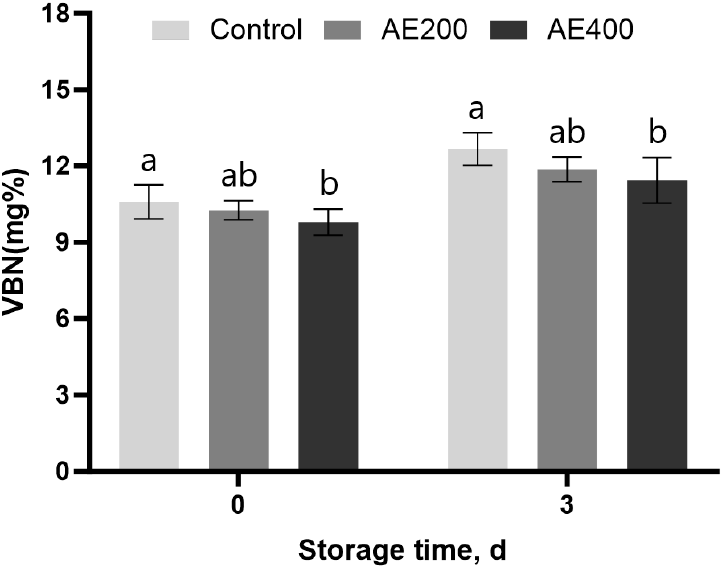
The effects of dietary AE supplementation on VBN values of broiler breast meat during storage are shown in Fig. 1. On d 0 of storage, the AE400 group showed lower VBN values than the control group (p < 0.05), whereas the AE200 group did not differ from either the control or AE400 group (p > 0.05). A similar pattern was observed on d 3 of storage. The AE400 group had lower VBN values than the control group (p < 0.05), while the AE200 group showed intermediate values with no significant difference from the other groups (p > 0.05).
Discussion
In the present study, dietary supplementation with AE did not affect the moisture, crude protein, or crude fat contents of broiler breast meat, indicating that AE supplementation at 200 or 400 mg/kg did not markedly alter the proximate composition of breast meat. Dietary plant extracts may influence nutrient digestion, metabolism, and meat quality depending on their source, active compounds, and inclusion level [8,9]. However, the absence of differences in moisture, crude protein, and crude fat in this study suggests that the AE levels used were not sufficient to change the proximate composition of broiler breast meat.
Crude ash content was higher in the AE200 group than in the control and AE400 groups. A. manihot has been reported to contain micronutrients such as iron, folate, and β-carotene [10], and phytogenic feed additives may influence nutrient utilization through their bioactive compounds [11]. Therefore, the increased crude ash content in the AE200 group may be related to mineral-related components in AE or changes in mineral utilization. However, this effect was not observed in the AE400 group, indicating that the ash result did not show a clear dose-dependent response. Therefore, further studies are needed to determine whether AE supplementation directly affects mineral deposition in broiler meat.
Collagen content was not affected by dietary AE supplementation. Collagen is a major fibrous protein in connective tissues and contributes to tissue structure in both humans and animals [12,13]. Although AE was expected to influence collagen-related traits because A. manihot contains compounds associated with collagen synthesis, collagen deposition is regulated by multiple biological and metabolic factors, including age, nutrition, hormones, growth factors, and tissue microenvironment [14]. Thus, the bioactive compounds in AE may not have been sufficient to increase collagen content in broiler breast meat under the present feeding conditions. Similar results were reported by Wójcik et al. [15], who found that dietary supplementation with garlic extract and β-alanine did not significantly affect collagen content in broiler leg or breast meat.
Cooking loss, drip loss, and shear force were also not affected by AE supplementation. Cooking loss is an important meat quality trait because water retention is closely associated with product yield and consumer acceptance [16]. It can be influenced by factors such as pH, final cooking temperature, heating rate, heating time, sample size, and meat composition [17]. In the present study, the lack of differences in cooking loss may be related to the absence of major changes in proximate composition. This result is consistent with a previous study reporting that dietary supplementation with dried sweet potato leaves and stems did not significantly affect cooking loss in broiler meat [18].
Drip loss is associated with changes in muscle microstructure and water movement from the intracellular space to the extracellular space during storage [19]. Because AE supplementation did not affect the proximate composition of breast meat in this study, it may also have had limited effects on the structural properties related to water loss. This result agrees with a previous study showing that dietary supplementation with mulberry leaf and dandelion extracts did not significantly affect drip loss in broiler meat [20].
Shear force is a major indicator of meat tenderness and consumer preference, and higher shear force generally indicates lower tenderness [21]. Collagen content is one of the factors contributing to meat toughness and texture [22]. In this study, the absence of differences in collagen content may partly explain why shear force did not differ among treatment groups. These findings suggest that dietary AE supplementation did not negatively affect the main physical quality traits of broiler breast meat.
In contrast to the meat quality traits, VBN values were lower in the AE400 group than in the control group on both d 0 and 3 of storage. VBN increases during meat storage as muscle proteins are degraded into amino acids and nitrogenous compounds by microbial and enzymatic activity, and it is widely used as an indicator of protein deterioration and freshness loss in meat [23,24]. The lower VBN values in the AE400 group suggest that AE supplementation at 400 mg/kg may help delay protein deterioration during short-term storage. Flavonoids such as rutin, hyperoside, isoquercitrin, quercetin, and myricetin have been identified in A. manihot flowers [25,26]. These flavonoids have been associated with antioxidant activity, which may partly contribute to reduced protein deterioration during storage.
Overall, dietary supplementation with AE did not change the major meat quality traits of broiler breast meat but reduced VBN values at 400 mg/kg. These findings suggest that AE may be more closely related to storage stability than to changes in proximate composition, collagen content, water loss, or tenderness. However, this study evaluated storage stability only on d 0 and 3 and did not include microbial counts or oxidative stability indices. Therefore, further studies are needed to clarify the optimal AE supplementation level and to evaluate its effects during longer storage periods.